http://photosdevoyage.fr.nf/

TRAVELLING AROUND THE WORLD

Click on the flag to acces the posts about :

ASIA
Please note that Tibet, Yunnan and Xinjiang are not independant countries but provinces or autonomous regions of China being a bit ethno-culturally different from the rest of PR China.
China
South Korea
Japan
Tibet
Xinjiang
Yunnan
NORTH AMERICA
USA
Mexico
Canada
EUROPE
Belgium
Luxembourg
Holland
Germany
Austria
Switzerland
Liechtenstein
England
Scotland
Italy
Monaco
San Marino
Vatican city-state
Spain
Andorra
Iceland
Norway
Sweden
Denmark
Finland

(some locations are still to be completed on this blog : China and Norway )

Affichage des articles dont le libellé est Tianjin. Afficher tous les articles

dimanche 27 janvier 2013

China - Tianjin last sights


Jul. 2012

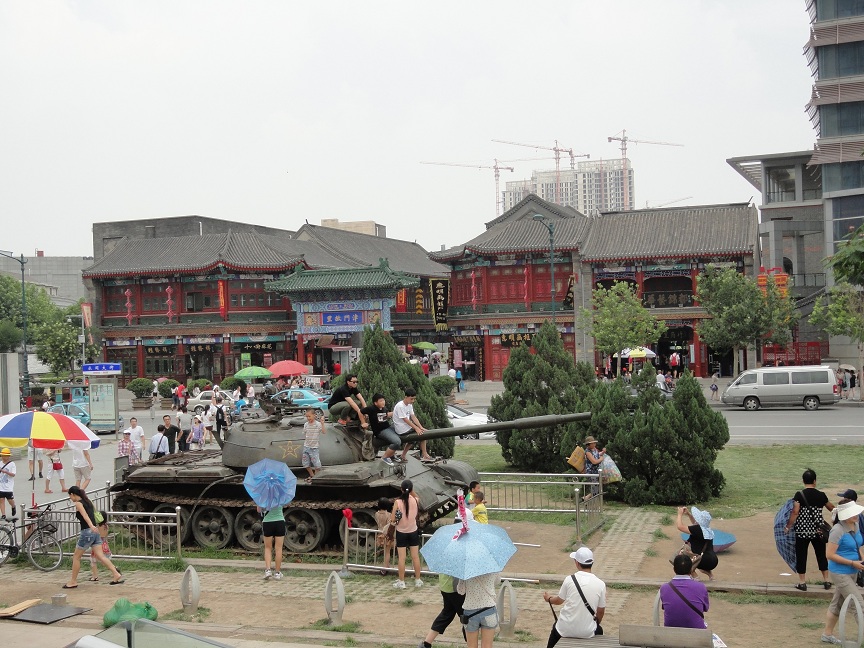
My stay in Tianjin lasted for only 2 days. On those pictures, you can see chinese people playing on memories from the world war, the new cathedral, the former cathedral, and finally a church.
Next : the most interesting part of this summer trip to China : Wutaishan.
Mon séjour à Tianjin n'aura duré que 2 jours. Sur ces photos, vous poyvez voir des chinois jouant sur des souvenirs de la guerre mondiale, la nouvelle catéhdrale, l'ancienne cathédrale, et une église.
A venir : la partie la plus intéressante du voyage en Chine de cet été : Wutaishan.

samedi 26 janvier 2013

China - Tianjin - temple of Great Compassion


Jul. 2012

Tianjin has a large variety of religious places, including some religions I had never heard about before coming here. I didn't have chance to visit them all, some of them being renovated. This one is a zen buddhist temple, the largest one of the city.
Tianjin dispose d'une grande quantité de lieux de cultes, y compris de religion dont je n'avais jamais entendu parler auparavant. je n'ai pu tous les visiter puisque certains étaient en cours de rénovation. Celui-ci est un temple bouddhiste zen, le plus vaste de la ville.

samedi 19 janvier 2013

mercredi 16 janvier 2013

samedi 12 janvier 2013

China - Tianjin 狗不理 Goubuli restaurant


Jul. 2012

Goubuli is one of the most famous dumpling (the baozi ones) brand in China, more than 150 year old. Chinese people seem to consider it as a kind of national treasure and can't imagine going to Tianjin without eating it. So i did. And that was actually good. Although "gou" means dog in mandarin, be sure there's no dog meat in it. It refers to a nickname of the brand's creator when he was a kid.
Goubuli est l'une des chaines de restaurants de ravioli (de baozi pour être plus précis) les plus célèbre de Chine, depuis déjà plus de 150 ans. Les Chinois semblent la considérer comme une sorte de trésor national et ne peuvent imaginer aller à Tianjin sans en manger. J'en ai donc eu. Et ils sont réellement bons. Bien que "gou" signifie chien en mandarin, soyez certains qu'il n'y a pas de viande de chien dedans. "gou" fait en fait allusion à un surnom d'enfance du fondateur de cette chaîne de restaurants.

dimanche 6 janvier 2013

China - Tianjin first sights


Jul. 2012

Tianjin needs about 2 or 3 hours driving by express way from Beijing and is one of the 4 direct controlled cities of China (not included in any province) as wel as the fourth biggest after Shanghai, Beijing and Guangzhou. In 1860, after a short war with french and english navies, Tianjin was opened to those countries,and thus to the rest of the world.
Here are the first pictures I shot there and some european influence can be felt in the local architecture.
Il faut deux à trois heures de conduite par autoroute depuis Pekin pour rejoindre Tianjin, qui est l'une des 4 municipalités autonomes de la Chine (ne faisant partie d'aucune province) de même que la quatrième ville la plus peuplée de Chine, après Shanghai, Beijing et Guangzhou (Canton). En 1860, après une courte guerre avec les marines française et britannique, Tianjin est ouverte à ces deux nations, et donc au monde extérieur.
Voici les premières photos prises là-bas. On peut sentir une influence européenne dans l'architecture locale.

mardi 24 juillet 2012

China 2012 appetizers - Tianjin and Wutaishan


Before, as I said not so long ago, resuming posting pictures of the march trip to Italy and San Marino republic, here is an appetizer of what's coming about my current trip in China. In my mind, those two pictures sum up my main feeling about Tianjin, a very modern city and Wutaishan, a place with high buddhist spirituality but where, strangely, most of chinese people practice buddhism with the spirit of the individual supermarket modern consumption life, running, shouting rudely, fighting with others to enter first into this or that place. And sometimes, like this old man, some quietness coming from another time.
Avant, comme je l'avais dit un peu plus tot, de reprendre la publication des photos du voyage de mars en Italie et république de Saint Marin, voici une mise en bouche de ce qui est a venir concernant mon voyage actuel en Chine. Dans mon esprit, ces deux photos résument mes impressions principales au sujet de Tianjin, une ville moderne, et Wutaishan, un haut lieu de la spiritualité bouddhiste mais où, étrangement, la plupart des chinois pratiquent le bouddhisme avec l'esprit de consommation de supermarché moderne, courant partout, criant parfois avec vulgarité, se battant avec les autres pour savoir qui entrera en premier dans tel ou tel lieu. Et parfois, comme ce vieillard, un calme venu d'une autre époque.


samedi 14 juillet 2012

China - Tianjin

I hadn't planed it. But here I am, visiting Tianjin for two days. This city is very modern and looks like we're in Europe. So far, I would say this is the most modern place I visited in China. I'll check its history more in details. Maybe it was widely destroyed during the world war. After having walked along the river, enjoying the sights of modern skycrappers, I'll try today to visit some temples, cathedrals and old more traditionnal things.

Je ne l'avais pas prévu. Mais me voici à Tianjin pour deux jours. Cette ville est très moderne et évoque fortement l'Europe. Jusqu'ici, je dirais que c'est l'endroit le plus moderne que j'ai visité en Chine. J'irais vérifier son histoire plus en détail. Peut-être a-t-elle été largement détruite durant la seconde guerre mondiale. Après une marche le long de la rivière, en appréciant la vue de gratte-ciels modernes, j'essaierais de visiter quelques temples, cathédrales et autres choses plus anciennes et traditionnelles.